
In the first article in this series, I wrote about basement floor insulation.
That was the starting point on a basement remodel I am working on in Bucks County. The house is a townhouse built in the 1990s. The family wants to turn an unfinished basement into a gym and home office.
The goal is not just to finish the basement.
The goal is to make it feel like part of the house.
Insulation helps with comfort. But insulation alone is not enough.
The next issue is moisture.
Basements are different from the rest of the house
Basements are below grade. That means they have a different relationship with water than the rooms upstairs.
Moisture can come from many sources.
It can come through the slab.
It can come through foundation walls.
It can come from exterior drainage problems.
It can come from plumbing.
It can come from a water heater.
It can come from humid air meeting cold concrete.
This is why I am careful with basement floor assemblies.
A finished basement floor should not simply cover the concrete. It should manage what may happen at the concrete.
The U.S. Department of Energy notes that moisture control includes managing vapor movement, air movement, temperature, and moisture content. Its moisture control guidance is a useful reminder that moisture problems are not always caused by visible water.
Sometimes the problem is vapor.
Sometimes it is condensation.
Sometimes it is trapped moisture with nowhere to go.
Do not trap water under the floor
I do not like pretending that a basement will never see moisture.
Basements often contain water heaters and mechanical equipment. Many have sump pits. The floor often already has a slight pitch for a reason.
That is why I am cautious when I see builders level basement floors without thinking through drainage.
A perfectly flat floor may be easier for finish installation, but that does not always make it better.
Where conditions allow, I prefer to maintain a slight pitch toward the sump pit. A common target is about 1/4 inch per foot, but the existing condition has to be evaluated in the field.
The principle is simple.
Do not trap water.
Give incidental moisture a path.
A dimple mat can help create that path
After insulation, the next question is how to protect the assembly from moisture.
On basement projects, I like to think in layers.
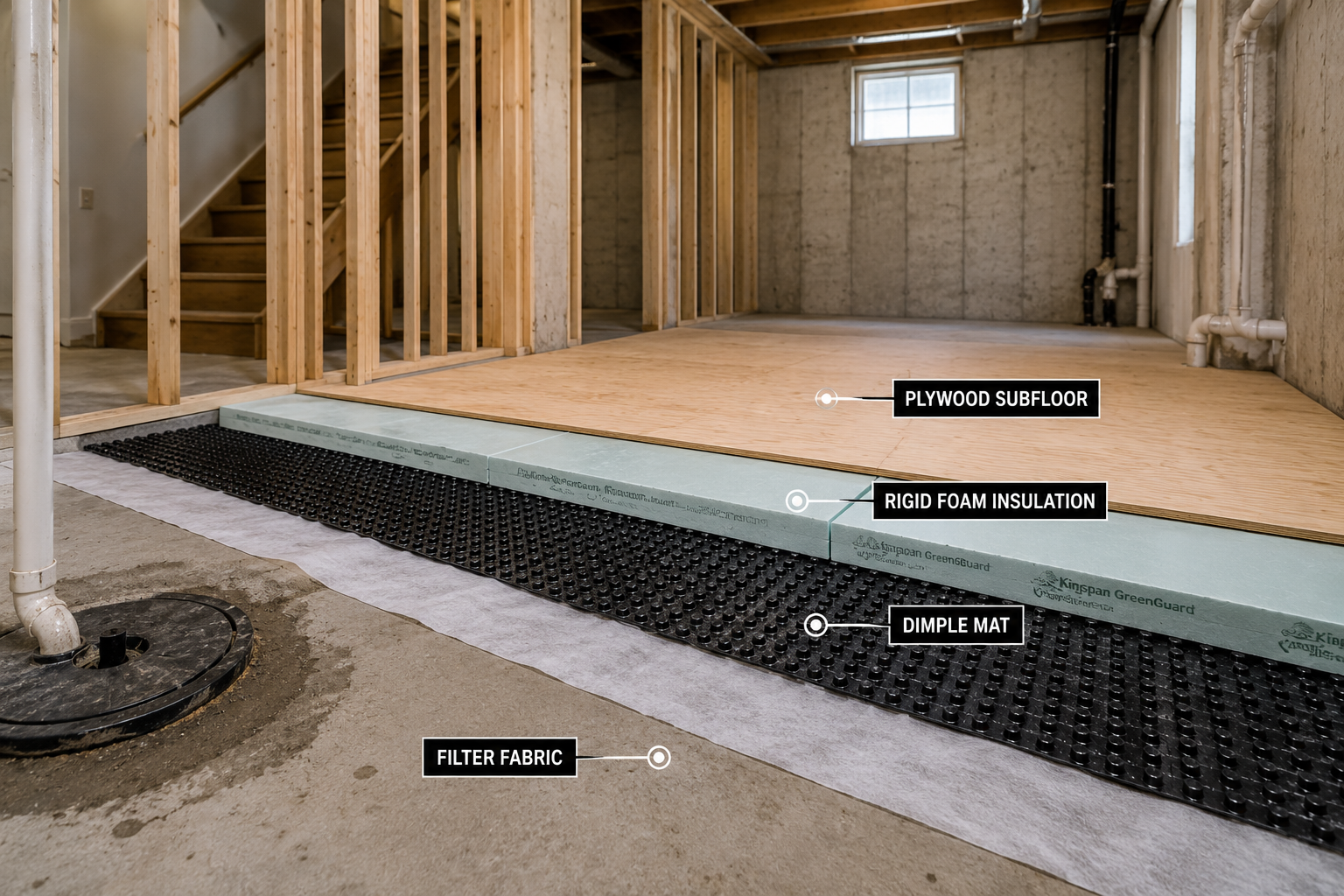
The first layer may be filter fabric over the slab. This helps separate the new floor assembly from the concrete. It also helps with dust control.
Above that, I like using a dimple mat where the condition calls for it.
Dimple mats are often used on the exterior side of foundation walls for drainage and moisture control. Under a basement floor assembly, the same basic idea can be useful.
The dimple mat creates a small air space above the slab. That space gives incidental moisture a path to move toward the sump pit instead of being trapped directly below insulation or finished flooring.
The rigid insulation then sits above the dimple mat. The plywood subfloor goes above the insulation. The finished flooring goes above that.
This approach does not replace good drainage.
If the basement leaks, the leak needs to be fixed first. Gutters, grading, foundation cracks, sump performance, and exterior drainage all matter.
A floor assembly should manage incidental moisture.
It should not be asked to solve a water problem that belongs somewhere else.
Condensation matters too
Moisture is not only liquid water.
Condensation can also damage a basement floor.
When warm, humid interior air reaches cold concrete, condensation can form. Building Science Corporation notes that slab insulation improves moisture damage resistance, including resistance to summertime condensation.
That is one reason insulation and moisture protection belong in the same conversation.
A warmer floor assembly is more comfortable. It can also reduce the risk of condensation at the cold slab.
This is how the first article connects to this one.
Insulation improves comfort.
Moisture protection helps preserve the assembly.
Together, they make the basement more durable.
Practical takeaways
Read the existing basement before designing the new floor.
Look for staining, efflorescence, dampness, cracks, and signs of past water.
Do not level a basement slab without understanding where water is supposed to go.
Maintain a drainage path to the sump pit where conditions allow.
Consider filter fabric and a dimple mat below the insulation when moisture management is a concern.
Fix active water problems before installing finished flooring.
A basement floor should not just be covered. It should be managed.
Continue the series
Previous article: Basement Floor Assemblies Start With Insulation
Next weeks article: Basement Floor Height Can Make or Break a Remodel
Closing prompts
Have you seen a finished basement develop a damp smell?
Have you had flooring fail after a basement remodel?
Tell me your stories.
Thanks for reading. If you enjoyed this post, please like, share, or explore my other articles at luisgile.com.


Leave a Reply