
This is the third article in my basement floor assembly series.
The first article addressed insulation. The second article addressed moisture protection. Both are important if you want a basement to feel like real living space.
But both create the same problem.
They add height.
That height has to come from somewhere.
In a basement, it usually comes out of the ceiling clearance.
On a basement remodel I am working on in Newtown, Bucks County, the family wants a gym and home office. The floor needs to feel warm. It needs to manage moisture. It also needs to fit.
That last part is where many basement remodels get into trouble.
Every floor layer has thickness
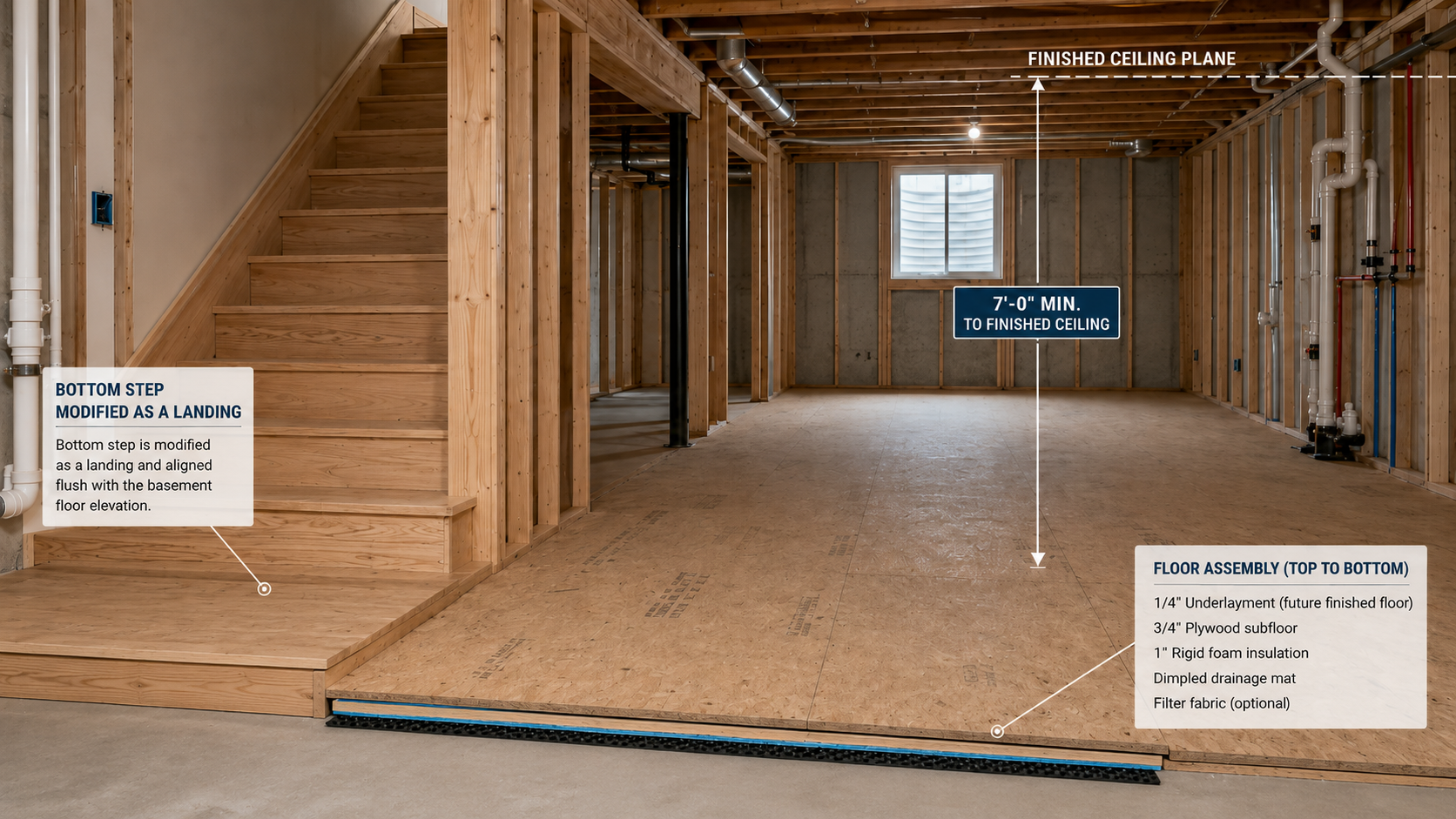
A good basement floor assembly may include several layers.
Filter fabric.
Dimple mat.
Rigid insulation.
Plywood subfloor.
Finished flooring.
Each layer has a purpose.
The insulation helps with comfort.
The dimple mat helps create a drainage space.
The subfloor creates a better surface for the finished floor.
But each layer also adds height.
That added height affects the whole basement. It affects ceiling clearance. It affects doors. It affects thresholds. It affects mechanical equipment. It affects the stairs.
This is why a basement floor assembly needs to be drawn or at least carefully measured before construction starts.
You cannot choose the layers in isolation.
The minimum ceiling height is usually 7 feet
Many homeowners think the minimum ceiling height for a finished basement is 7′-6″.
That is not the general IRC rule.
Under IRC Section R305, habitable space, hallways, and portions of basements containing those spaces generally require a ceiling height of not less than 7′-0″. Bathrooms, toilet rooms, and laundry rooms may be allowed at 6′-8″, subject to the specific code condition and local enforcement. This IRC ceiling height summary provides a clear reference to the 7′-0″ minimum for habitable basement spaces.
Local amendments still matter.
The building department has the final say.
But the important point is that floor height counts against you. The code height is measured from the finished floor to the finished ceiling. If you add insulation, subfloor, and flooring, you reduce the finished ceiling height.
That can be the difference between a compliant room and a problem.
Stairs are usually where the mistake shows up
The ceiling height issue is important, but the stair issue is often more noticeable.
When you raise the basement floor, you shorten the bottom riser of the stair.
That may not sound like a big deal.
It is.
People feel inconsistent stairs immediately. A short first riser feels awkward. It interrupts the rhythm of the stair. It can also create a trip hazard.
Stair risers are expected to be consistent within a flight. Common IRC guidance limits the difference between the tallest and shortest riser in a flight to 3/8 inch. This stair geometry handout summarizes the rule clearly.
That means you cannot simply build up the basement floor and ignore the stairs.
The stair has to be part of the design.
The bottom step can sometimes become a landing
There is often a practical solution.
The bottom step of the basement stair can sometimes be modified to act as a landing.
This can help address the discomfort of a shorter first riser. It can also help create a cleaner and more code-conscious transition from the stair to the new finished basement floor.
But this has to be designed.
The landing depth matters.
The stair geometry matters.
The handrail condition matters.
The headroom matters.
The local code interpretation matters.
It is not just carpentry. It is part of the basement design.
When done properly, treating the bottom step as a landing can solve a common basement remodel problem. It acknowledges that the finished floor height changed and then makes the stair work with the new condition.
Do not solve comfort by creating a clearance problem
The first two articles in this series make the case for insulation and moisture protection.
I still believe those are important.
But they have to fit.
Before committing to the floor assembly, measure the existing basement height in several locations. Basements are not always level. Beams, ducts, pipes, soffits, and stair headroom can create lower points.
A floor assembly that works in the center of the room may create a problem at the stair, under a duct, or near a doorway.
This is why the floor assembly should be coordinated early.
Comfort matters.
Moisture protection matters.
Clearance matters too.
Practical takeaways
Confirm existing ceiling height before selecting the floor assembly.
Remember that the general IRC minimum for habitable basement space is 7′-0″, not 7′-6″, subject to local review.
Add up the full thickness of every floor layer before construction starts.
Check the bottom stair riser after the new floor height is established.
Consider modifying the bottom step into a landing when appropriate.
Review doors, thresholds, mechanical equipment, beams, ducts, soffits, and stair headroom before finalizing the design.
A basement floor assembly has to perform, but it also has to fit.
Complete the series
Previous article: Basement Floors Need Moisture Protection Before Finished Flooring
Suggested previous-article link prompt for WordPress:
Related article: Basement Floor Assemblies Start With Insulation
Closing prompts
Have you added flooring in a basement and noticed the first stair felt wrong?
Did ceiling height limit what you could do with a basement remodel?
Tell me your stories.
Thanks for reading. If you enjoyed this post, please like, share, or explore my other articles at luisgile.com.


Leave a Reply